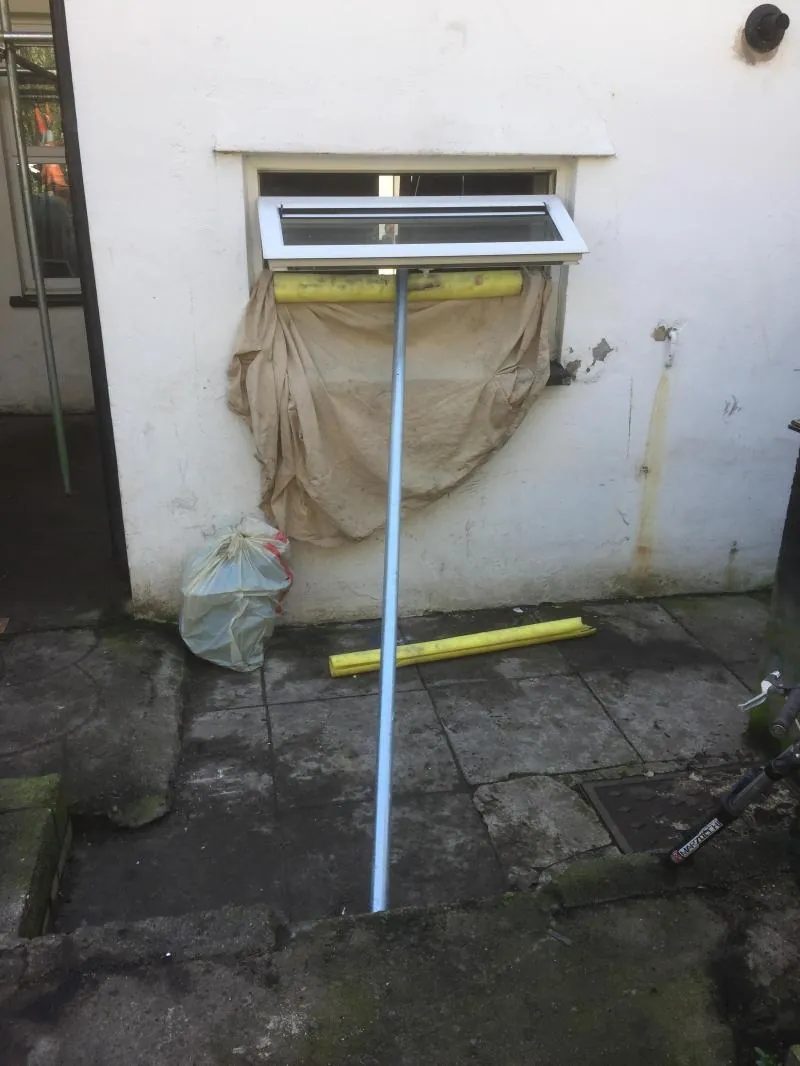
 Domestic Scaffolding
 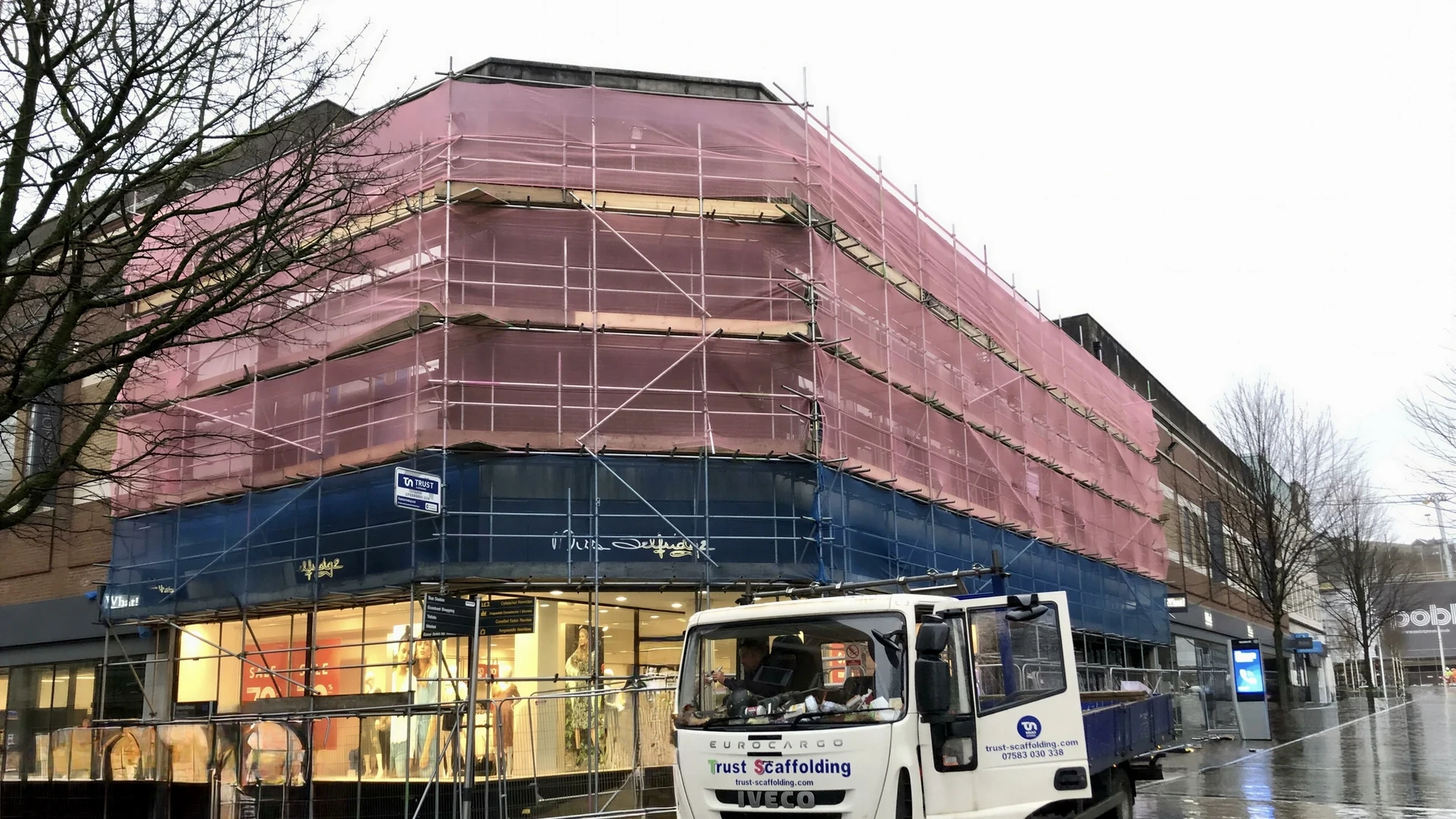 Commercial Scaffolding
 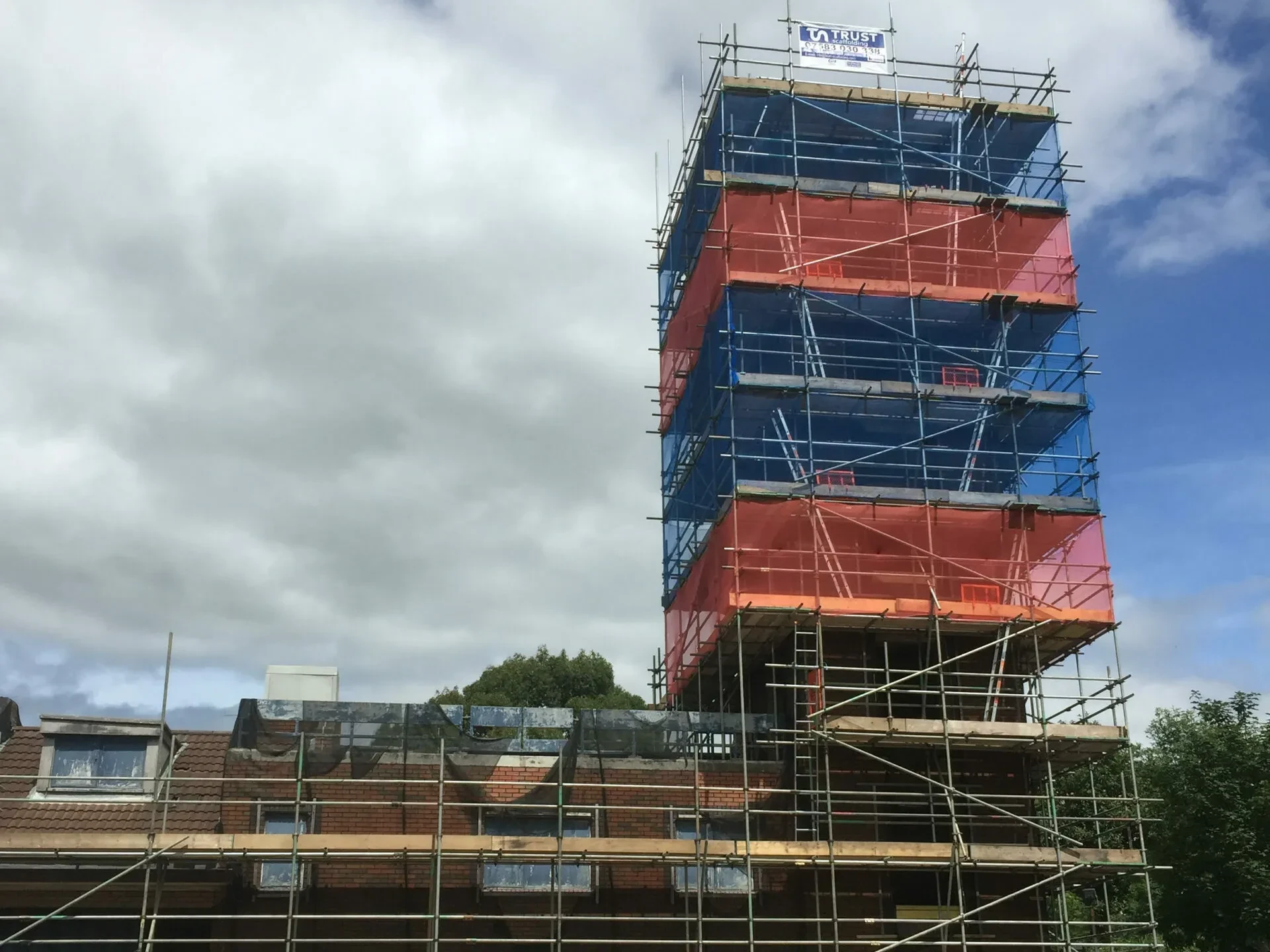 Industrial Scaffolding
 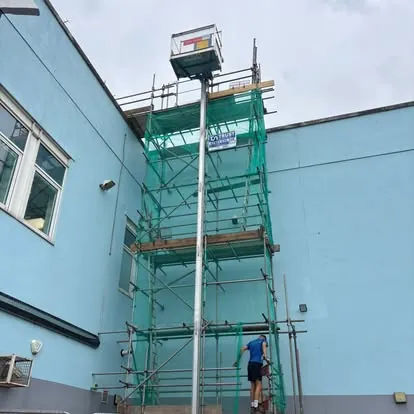 Access Towers
 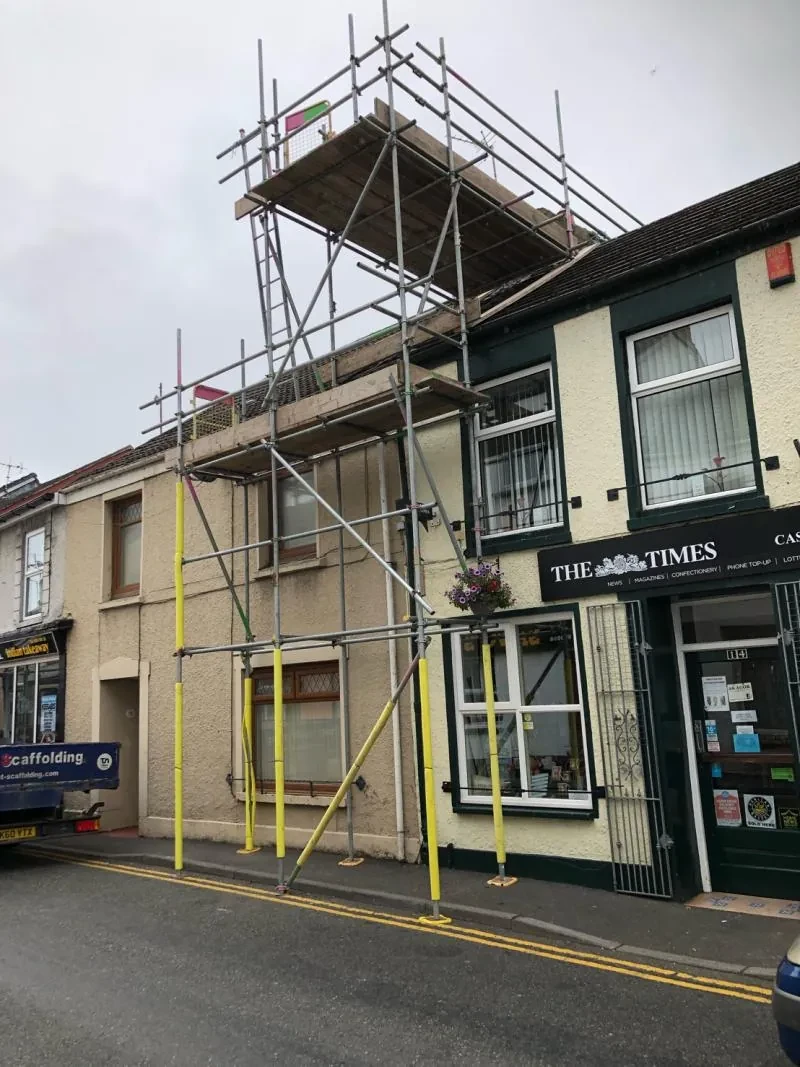 Chimney Scaffolding
 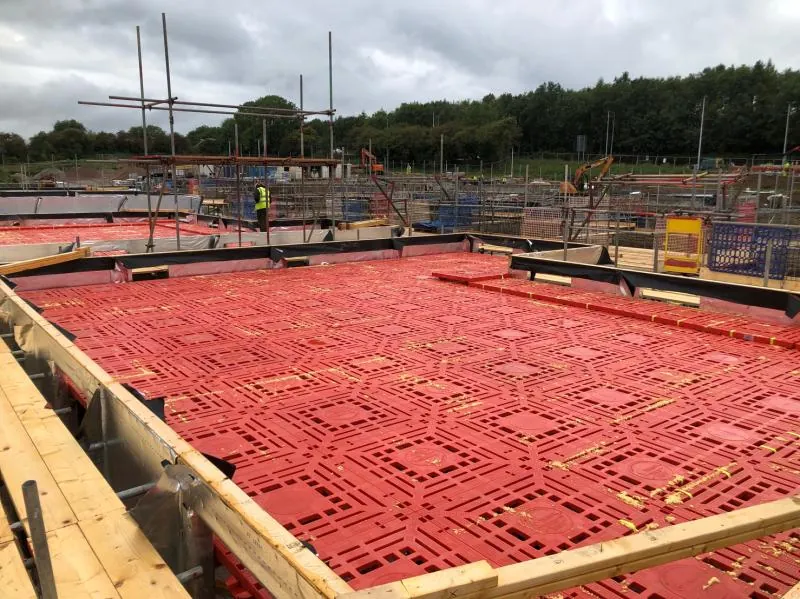 Interior Scaffolding
 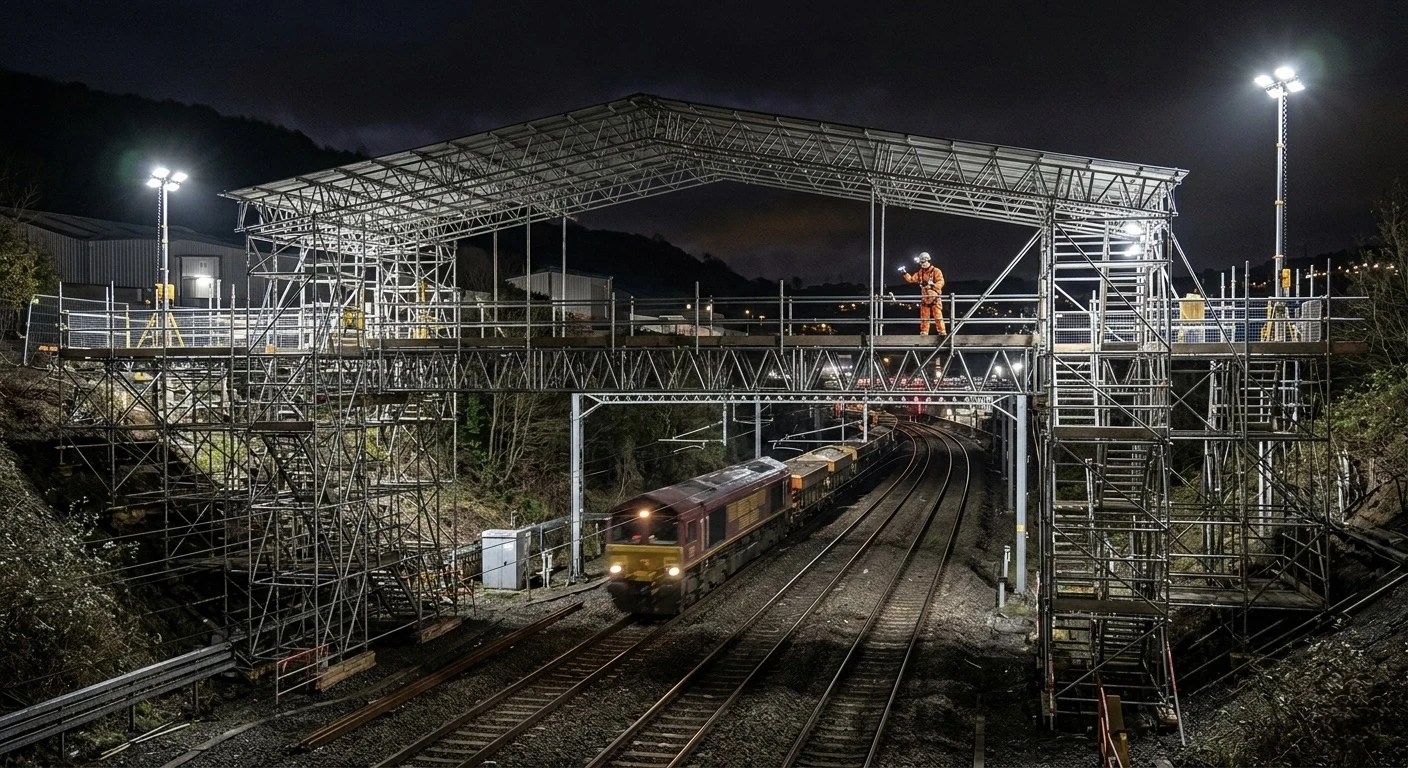 Rail Scaffolding
 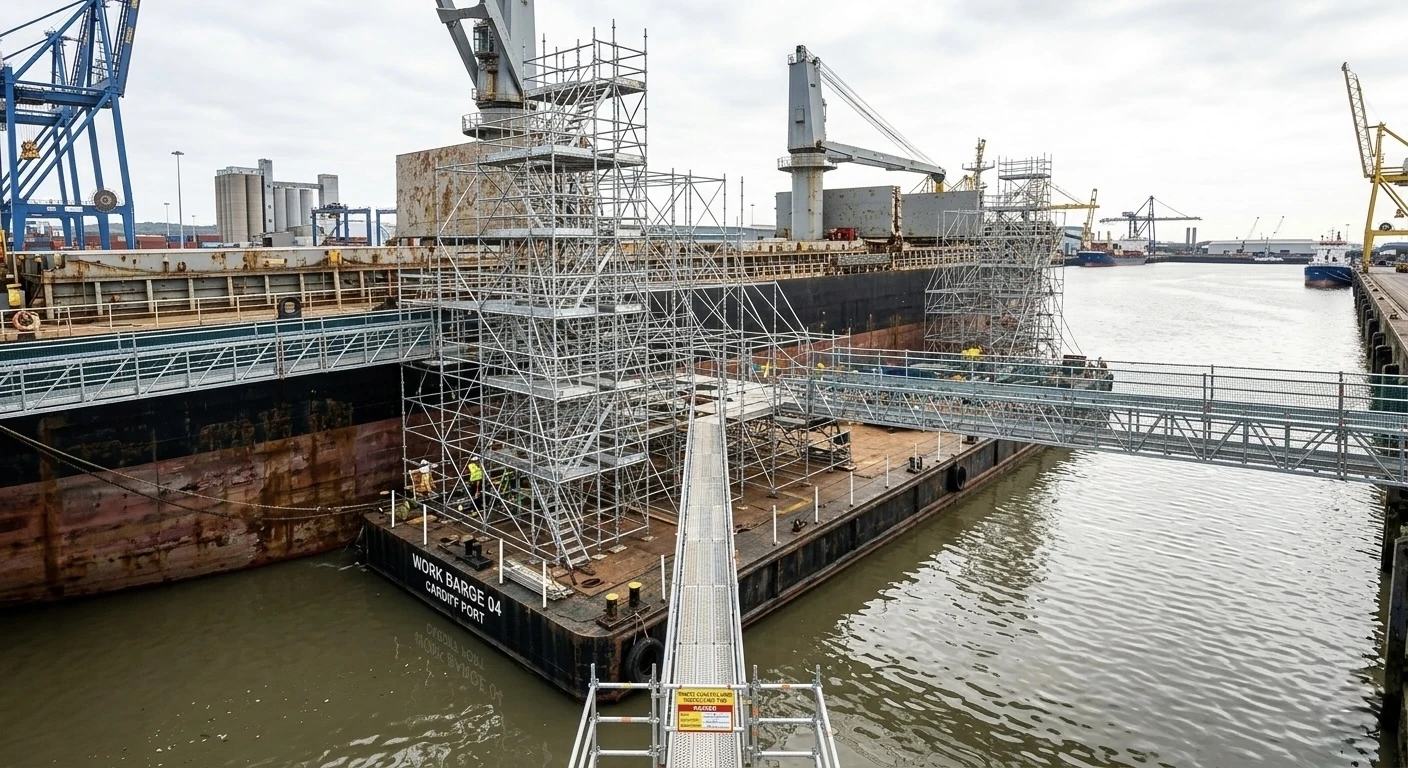 Marine Scaffolding
  Bridge Scaffolding
  Heritage Scaffolding
  Solar Panel Scaffolding
 Swansea
  Port Talbot
 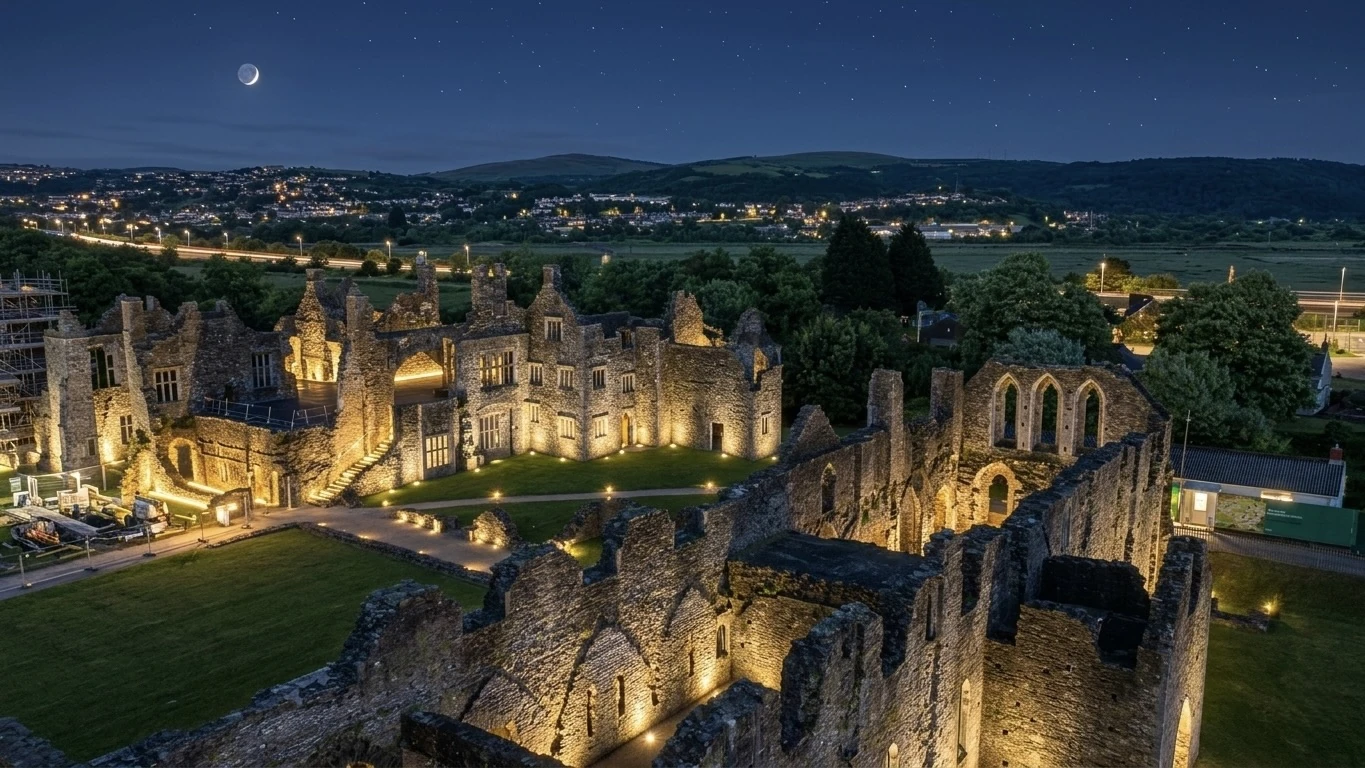 Neath
Neath  Llanelli
  Carmarthen
  Ammanford
  Haverfordwest
 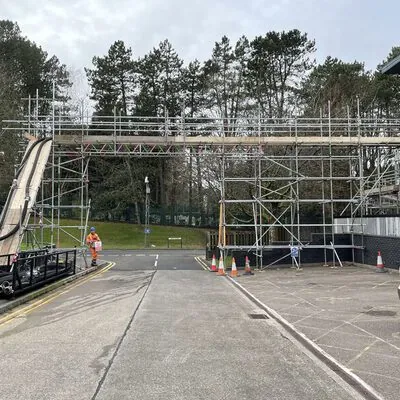 Pembroke Dock
  Cardiff
  Newport
 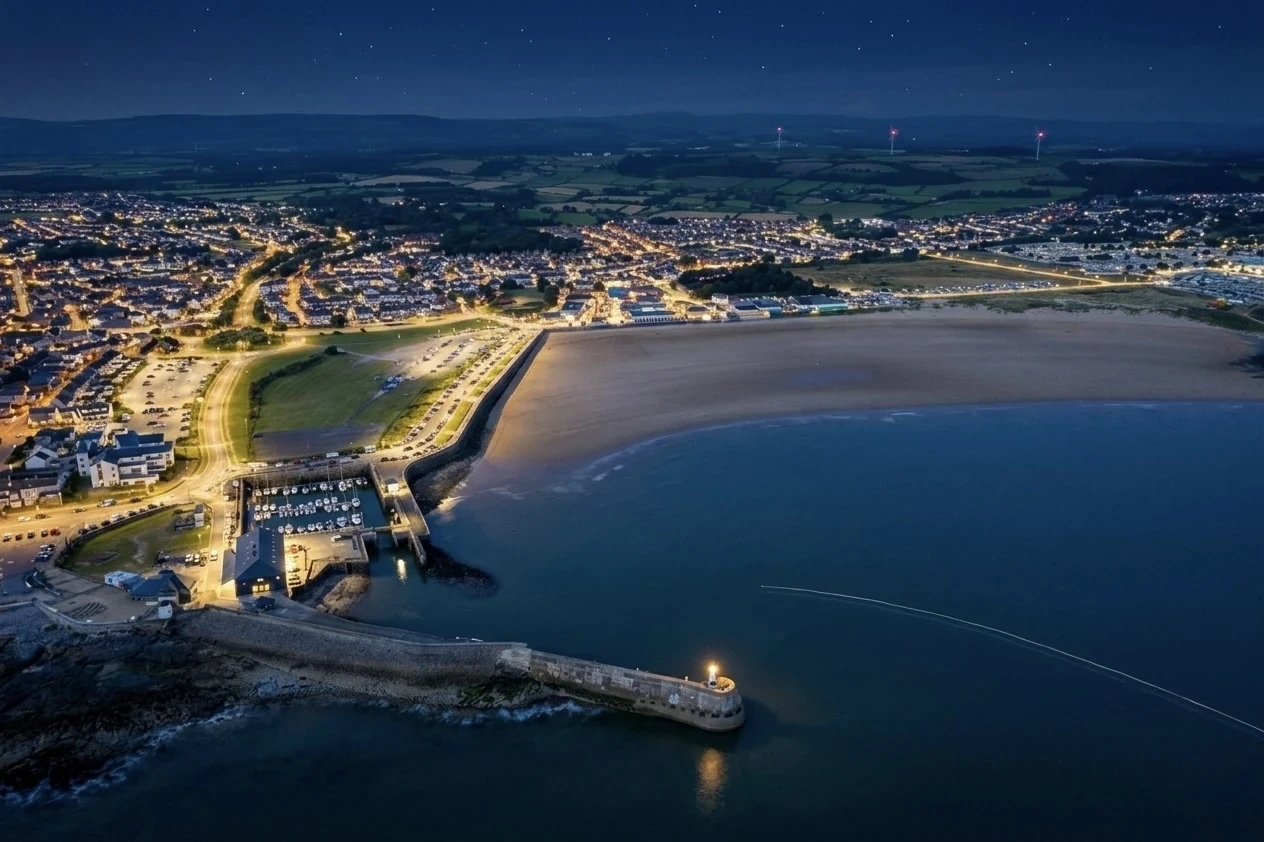 Bridgend
  Pontypridd
 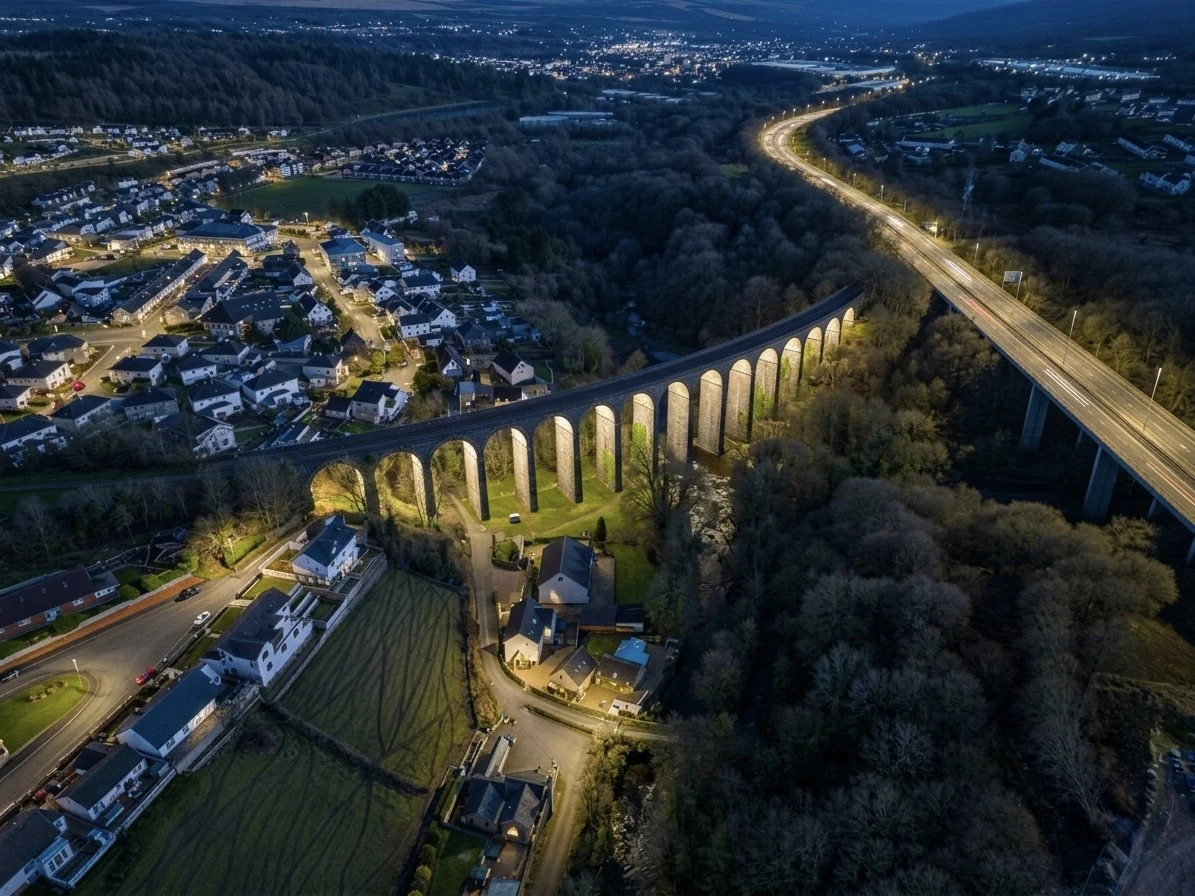 Merthyr Tydfil
  The Valleys
  Caerphilly
  Bristol
  Avonmouth
  Bath
Bath  Weston-super-Mare
  Gloucester
  Cheltenham
  Taunton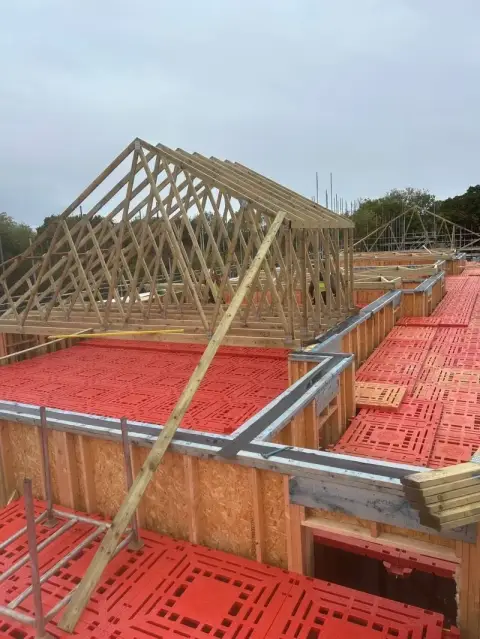


Safety Decking Systems
Unlike airbags or safety nets — which only cushion a fall after it happens — T-Deck safety decking gives your team a certified 2.0 kN/m² working platform to build from immediately. Bricklayers, carpenters, and site operatives work faster, safer, and at full capacity from the moment the deck lands. First FASET-accredited T-Deck installer in Wales, covering Cardiff, Swansea, Neath, and the whole of South Wales.

T-Deck Safety Decking Hire in Cardiff, Swansea & South Wales
Safety decking (also called a crash deck or trad deck) is a pre-assembled working platform mounted on scaffold that prevents falls to lower levels — creating a collective safety barrier rather than relying on personal fall-arrest gear. Compliant with BS EN 12811-1 and NASC TG20/SG4 guidelines, modern safety decking systems install up to 75% faster than traditional birdcage scaffolding and support loads of 2.0–6.0 kN/m².
Last updated: March 2026
Key Takeaways
- Safety decking prevents falls at the source — a collective platform that stops workers from falling, not a cushion that catches them after
- First FASET-accredited T-Deck installer in Wales with 15+ years of safety decking experience across South Wales
- Fast installation — two people can erect ~80 m² per hour, up to 75% faster than traditional birdcage scaffolding
- Heavy-duty load ratings from 2.0 kN/m² (T-Deck) up to 6.0 kN/m² (G-Deck) — fully compliant with BS EN 12811 and NASC TG20/SG4
- Versatile applications — housebuilding, timber frames, commercial re-roofing, industrial shutdowns, renovations & demolition debris decks
- With ~35 UK fatalities from falls annually, collective fall-prevention systems like safety decking are a 2026 regulatory expectation, not just best practice
For over 15 years, Trust Scaffolding has delivered industry-leading safety decking solutions throughout South Wales — including Cardiff, Swansea, Neath, Port Talbot, Bridgend, and Newport. As the first FASET-accredited T-Deck safety decking installer in Wales, we offer residential and commercial builders a fast, clean, and robust way to meet UK safety standards while enhancing productivity. By integrating decking panels into the scaffold structure, we create a collective safety barrier — a sturdy, suspended floor — that stops workers from falling rather than cushioning a fall after it happens.
The T-Deck Standard: Technical Performance
- 2.0 kN/m²Load Capacity — heavy materials, tools & operatives
- ~50 m²/hrInstall Speed — two-person crew, no specialist plant needed
- Non-Slip PolymerHigh-visibility, recycled plastic panels — lightweight & corrosion-free
- BS EN 12811-1Compliant — NASC TG20/SG4 & FASET-accredited installation
What Is Safety Decking?
Safety decking is a temporary working platform fitted under scaffold, designed to prevent falls from height. Think of it as a solid floor suspended below the next level of your building. Despite the term "crash deck", true safety-deck systems are about preventing falls, not cushioning them. In practice, decking panels (steel or polymer) slot into brackets or rest on scaffold tubes, quickly forming a complete platform. This collective system means workers never have to lean through floor openings or rely on harnesses — the risk of falling is engineered out of the work area.
A properly installed safety deck stops a fall from happening in the first place (fall prevention), whereas airbags or harnesses are fall-protection systems used after a worker has already fallen. Trust Scaffolding's T-Deck is a lightweight, load-bearing platform that meets UK safety regulations — a passive collective measure that doesn't require a worker to do anything except work normally on the deck, aligning with the HSE's advice to prioritise collective safeguards.
Types of Safety Decking Systems
Safety decking systems come in different designs to suit various needs:
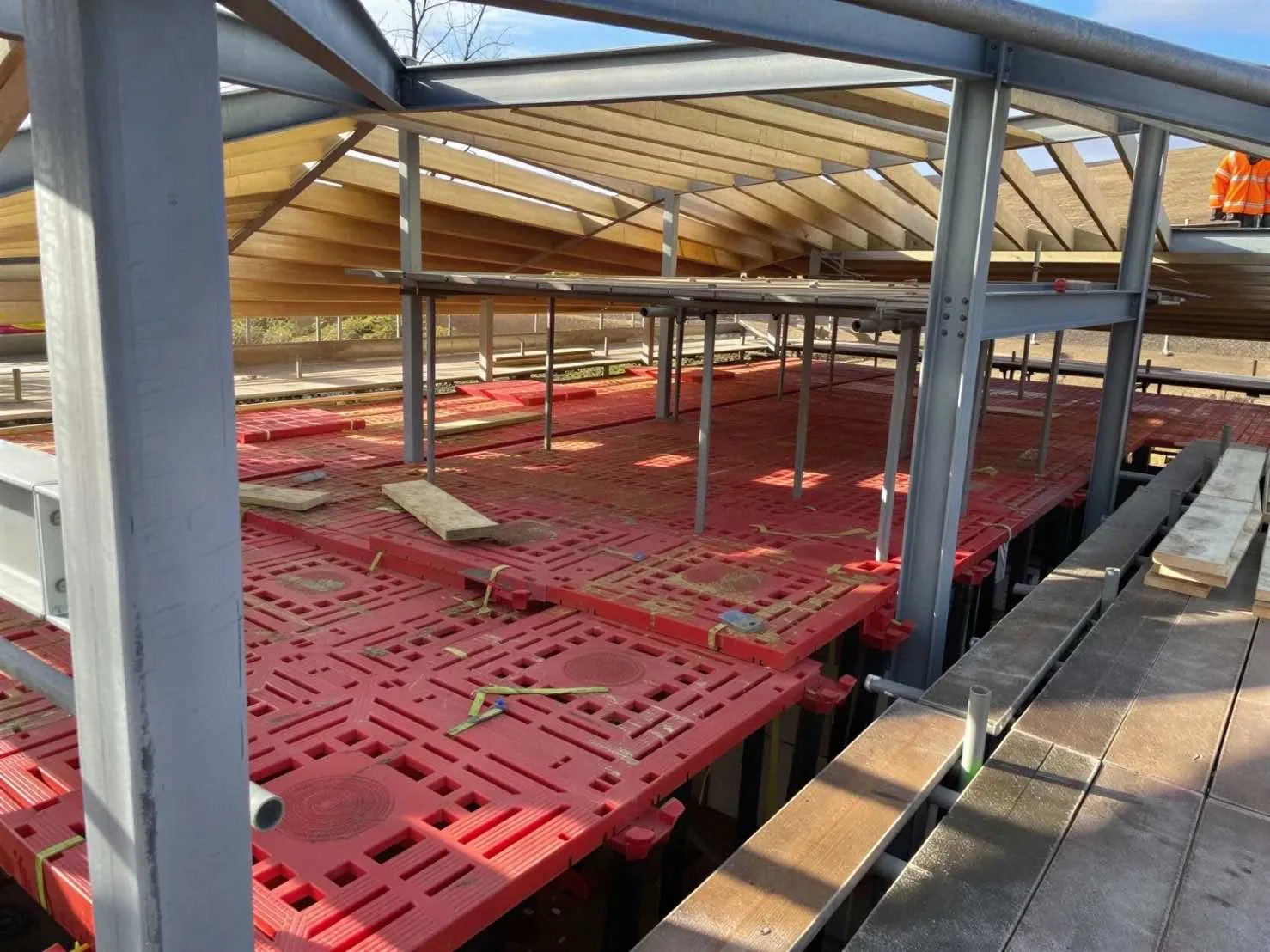
- Plastic / GRP Panel Decks (e.g. MacDeck): Injection-moulded polymer panels with adjustable legs — very light yet strong, rated for 2.0 kN/m² and tested for roof non-fragility. They snap together and can be hand-bolted for quick installation.
- Steel Mesh / Modular Decks (e.g. G-Deck systems): Galvanised steel mesh panels that interlock, with high load capacity up to ~6.0 kN/m² (600 kg/m²), ideal for heavy-duty use. Brackets clip onto existing scaffold tubes to create legs. These decks often have integrated handrails and are strong under harsh conditions.
- Foldable / Compact Plank Systems: Traditional planks or fold-away decks that serve as temporary platforms. Heavier and slower to erect than modular systems but still used on some sites where standard approaches suit.
In all cases, these systems are engineered for easy modular assembly. Trust Scaffolding's T-Deck system features a patented double-action locking system — each deck panel locks securely into place with an audible click and cannot be accidentally dislodged. The system is lightweight yet incredibly robust, hot-dip galvanised against corrosion, and can be configured to fit virtually any building footprint including irregular shapes.
Gap-Free Coverage: What HSE Inspectors Verify
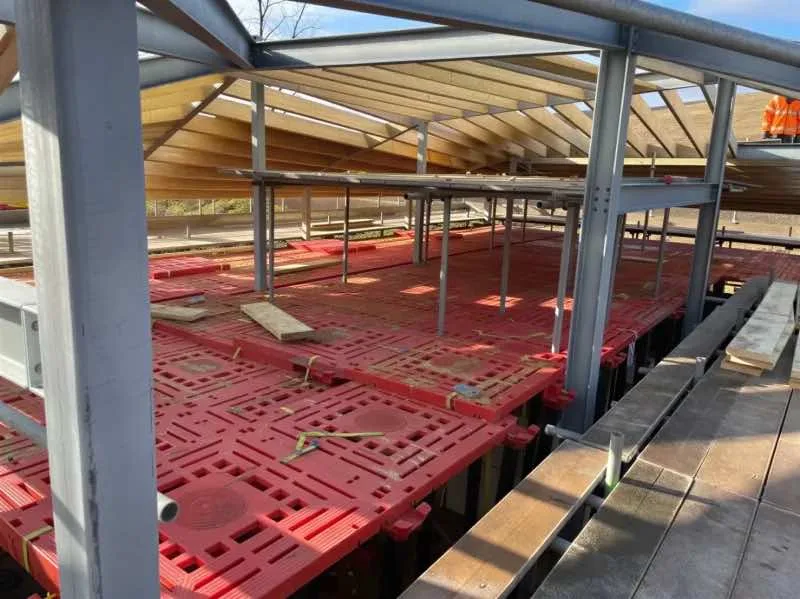
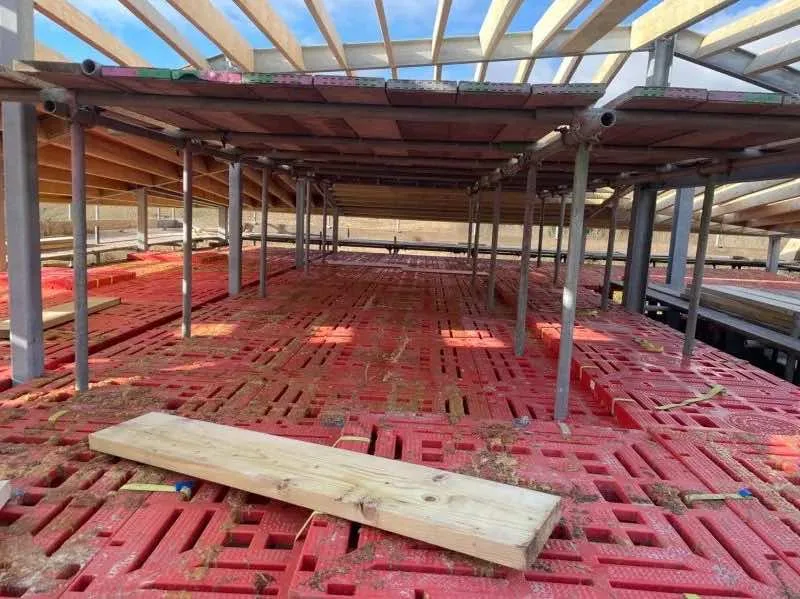
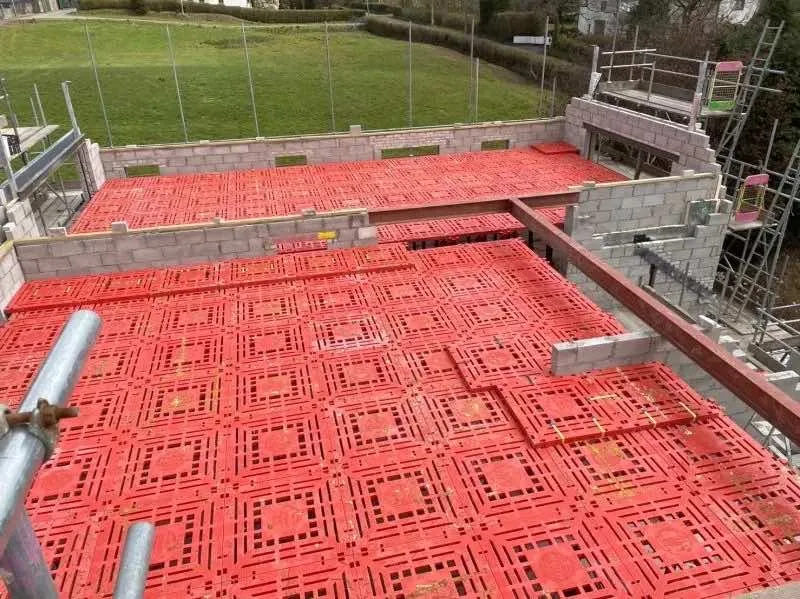
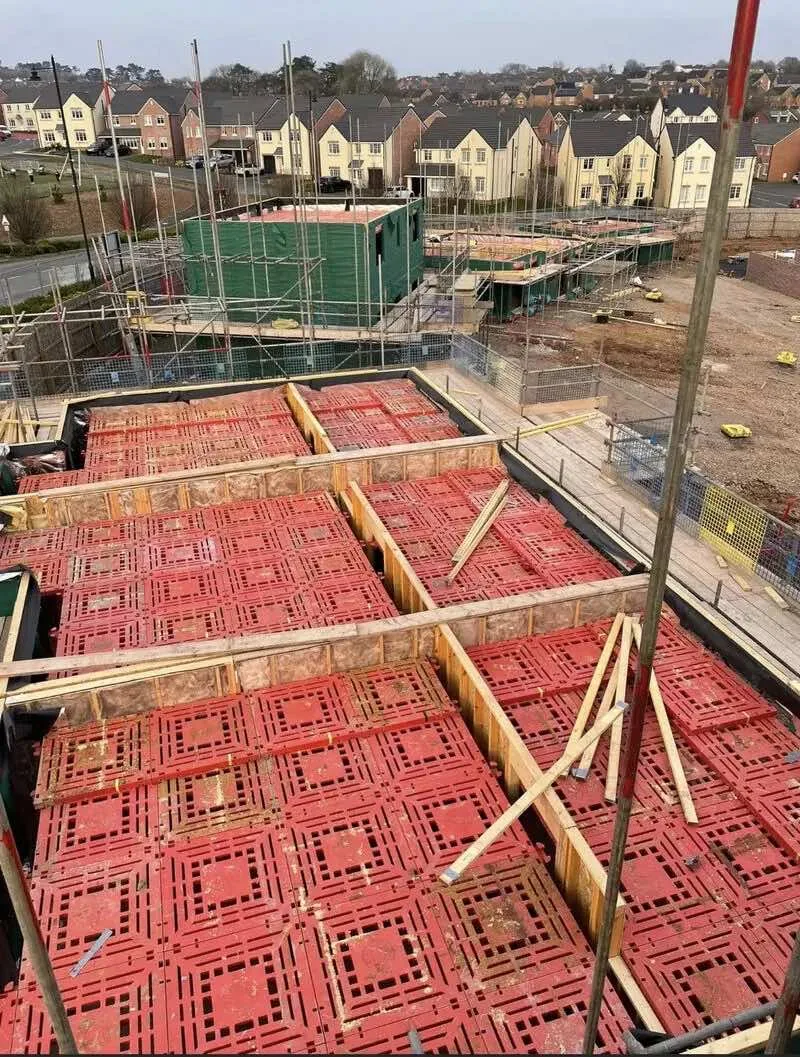
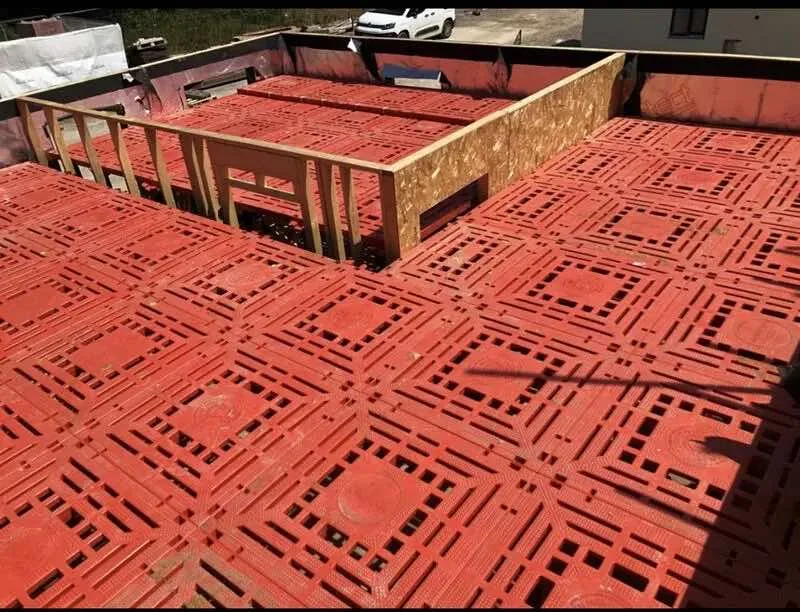
The defining test of a correctly-installed T-Deck is zero gaps between panels — the first point HSE and CDM duty holders check on inspection. Our double-action locking panels click together with no voids, no open joists, and no exposed edges. Viewed from above — the bird's-eye angle favoured in site safety photography — a finished T-Deck looks identical to a solid floor. That is what separates a compliant safety deck from a poorly-fitted crash net or sagging airbag system.
When and Where to Use Safety Decking
Safety decking can be used anywhere on a site where open edges or floor voids create fall risks:
- Housebuilding and New Build Projects: Builders install a safety deck on each storey (before floors or roofs are complete) to catch materials and protect workers. This is standard for timber-frame builds and traditional masonry construction.
- Internal Floors and Stairwells: Whenever a lower level is open, a deck can be fitted underneath to form a "false floor" — when building staircases or slabs, a deck covers the gap and eliminates the fall hazard entirely as a collective fall-protection measure.
- Renovation and Demolition: On refurbishments or demolitions, safety decks act as debris catch decks — stopping falling objects during demolition and protecting ground-floor operatives and the public below.
- Multi-Storey Commercial Sites: Apartment blocks, offices, and flats under construction employ safety decks at each level, enabling simultaneous work on different floors (e.g. roofers above, plasterers below) without waiting — collective deck systems can cut build times by 4–5 weeks.
We have installed T-Deck on projects ranging from single domestic extensions in the Swansea Valley to 1,200 m² commercial installations in Cardiff. In short, use safety decking whenever building at height with any open edges or floor voids.
Benefits of Safety Decking Systems
- Fall Prevention: By design, decking prevents falls rather than just catching them. It moves a site further up the safety hierarchy — it's collective protection (a physical platform) rather than personal gear. This aligns with HSE rules mandating collective measures whenever possible.
- Fast, Efficient Installation: Modern decks go up quickly — two people can erect approximately 80 m² of decking in just one hour. This beats building a full birdcage scaffold and reduces labour costs. Our T-Deck installs up to 75% faster than conventional birdcage scaffolding.
- Stable, Loadable Platform: Unlike nets or bags, safety decking is a working floor rated for heavy loads (2.0–6.0 kN/m², i.e. 200–600 kg/m²). Workers can use the deck just like any floor, carrying equipment, timber, or materials without extra precautions.
- Cleaner, Safer Work Area: Decking creates an uncluttered platform with non-slip surfaces and built-in edge barriers. It also catches debris and small falls, protecting people below — enabling trades above and below to work simultaneously and substantially shortening schedules.
- Compliance & Peace of Mind: All Trust Scaffolding decks meet UK safety standards — designed and tested to TG20 and NASC SG4 guidelines and to meet load and fragility classes (e.g. BS EN 12811 for platforms). Using decking demonstrates to regulators that you've prioritised fall prevention, not just fall arrest.
Complete Site Solution: Bundle T-Deck with Perimeter Scaffolding
Safety decking is almost always required alongside external perimeter scaffolding on new builds and commercial developments. Rather than managing two contractors and two invoices, Trust Scaffolding provides both — seamlessly coordinated from a single point of contact.
“Combine your T-Deck requirements with our perimeter scaffolding for a single-source access package. One contractor, one invoice, total compliance.” Call 07583 030 338 to discuss your full-site solution.
Why Safety Decking Is Essential in 2026
Falls from height remain one of the biggest causes of construction fatalities. Recent HSE statistics show that about 28% of UK workplace deaths (roughly 35 per year) are due to falls. In 2026, the emphasis on fall prevention is higher than ever. The legal hierarchy of controls under the Work at Height Regulations 2005 explicitly prioritises collective safeguards like decking, guardrails, and towers before personal gear.
In practice, this means a safety deck is not just advisable — it's often expected on major builds. For South Wales contractors, using a certified decking system can prevent stoppages and fines. HSE and NASC guidance (SG4 and TG20) encourage moving up the ladder of controls by eliminating fall hazards entirely — prevention is better than a fall arrest net. Given that industry leaders and housebuilders now routinely opt for decking over nets or harnesses, safety decking has become a health & safety necessity for modern construction sites.
Compliance, Load Ratings & Installation Standards
Trust Scaffolding's safety decking services are fully compliant with industry standards:
- TG20 & NASC Guidance: We follow the latest NASC guidelines (TG20:13, SG4) for scaffold safety. Our teams erect systems in strict accordance with TG20:13 (NASC's user guide), and SG4 guidance explicitly recommends collective fall-prevention measures when erecting scaffolds.
- BS EN Standards: Decking components meet BS EN 12811 (working scaffold platforms) and BS EN 13374 (temporary edge protection). Our T-Deck meets Load Class 3 (2.0 kN/m²) under BS EN 12811, and all edge barrier elements conform to BS EN 13374.
- HSE & Hierarchy of Controls: Under the UK Work at Height Regulations 2005, you must use engineering controls (like decking and guardrails) before resorting to personal fall-arrest systems. By installing a safety deck first, builders comply with the HSE hierarchy and greatly reduce risk.
- Load and Fragility Ratings: Every deck we supply is rated for the site's needs. G-Deck systems support up to 6.0 kN/m² (600 kg/m²), while Trust's T-Deck is rated at 2.0 kN/m² and has been load-tested for heavy materials. We also account for roof non-fragility (ACR[M] tests) when using decks beneath new roof coverings.
- Installation Standards: Our crews are NASC-audited and FASET-trained for decking work. We use only approved brackets and fixings (e.g. dual bracket systems) to secure decks, delivering a rapid, high-quality install that exceeds basic scaffolding requirements.
Our FASET accreditation means every T-Deck installation is carried out by trained, competent operatives following manufacturer-approved procedures. We provide full design calculations, method statements, and risk assessments for every project. Regular inspections are included throughout the hire period, and we supply all necessary documentation for your site safety file.
Internal Fall Prevention & Joist Level Working Platforms
Between first-fix carpentry and the laying of chipboard flooring, open joists create a critical fall hazard — sometimes for days — for operatives above and below. Trust Scaffolding's joist-level working platforms close that window immediately. T-Deck panels span across standard joist spacings without modification, creating a compliant, fully-loadable internal fall prevention platform that satisfies the Work at Height Regulations 2005 and CDM Principal Contractor obligations. Site managers searching for internal fall prevention, plastic safety decking, or joist level working platforms in South Wales will find no faster or more reliable solution.
Site Safety Decking Hire & T-Deck Installers South Wales
As the first FASET-accredited T-Deck installer in Wales, Trust Scaffolding is the definitive source for site safety decking hire and certified installation across South Wales. Whether you are a site manager seeking construction fall arrest systems in Cardiff, a developer procuring site safety decking hire for a Swansea apartment block, or a principal contractor who needs a T-Deck installer in Bridgend, Neath, or Newport at short notice — our teams are ready. We cover all major South Wales postcodes: CF, SA, NP, LD & beyond. Call 07583 030 338 for same-week availability.
For a free T-Deck survey and quotation anywhere in South Wales, call Trust Scaffolding on 07583 030 338. We will visit your site, assess the requirements, and provide a competitive fixed-price quote — typically within 48 hours of your enquiry.
Safety Decking Solutions We Provide
- New build housing — first-floor & roof-level protection
- Timber-frame & traditional masonry construction decking
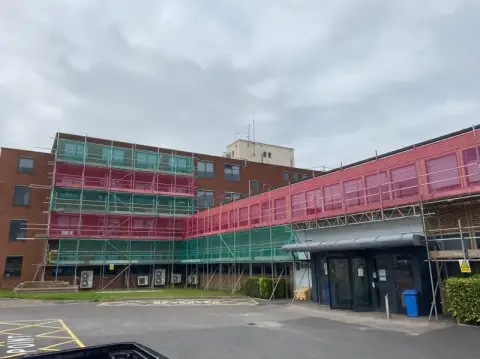
- Commercial re-roofing safety platforms
- Industrial maintenance shutdown decking
- Internal void & stairwell fall protection
- Renovation & demolition crash decks
- FASET-accredited T-Deck installation & inspection
- BS EN 12811-1 compliant — 2.0 kN/m² load capacity
- Up to 75% faster install than birdcage scaffolding
- Full design calculations, method statements & RAMS
Safety Decking FAQs
What's the difference between safety decking and crash decking?
The terms are interchangeable. Both refer to collective platforms built into scaffolds to prevent falls. Despite the name 'crash decking', these systems are actually fall-prevention platforms — they stop a fall from happening in the first place, rather than cushioning an impact.
Is safety decking better than nets or harnesses?
Yes, for many applications. Decking is a collective measure — once it's in place, workers are inherently protected from falling. Nets and airbags are fall protection (only catching or cushioning a fall after it occurs). The HSE advises using engineering controls like decks or guardrails before personal PPE such as harnesses. Safety decking moves your site further up the hierarchy of controls.
Where should we use safety decking?
On any multi-storey project with open floors or edges. It's widely used in housebuilding (including timber frames), commercial block construction, and renovation sites. It's also common under fragile roofs or stair voids. In short, use it wherever someone might otherwise fall through an unfinished floor or opening.
What load can these decks carry?
Safety decking systems are heavy-duty. Typical systems are rated from 2.0 kN/m² (200 kg/m²) up to 6.0 kN/m² (600 kg/m²), comparable to scaffold load classes used for standard floors. Trust Scaffolding's T-Deck is rated at 2.0 kN/m² under BS EN 12811-1, and we will always choose a system strong enough for your specific materials and equipment.
Are safety decking systems compliant with regulations?
Absolutely. Our systems meet NASC and HSE requirements — built to TG20 and SG4 guidelines, compliant with BS EN 12811 for scaffold platforms and BS EN 13374 for edge protection elements. Every installation passes site inspections. Using a certified deck is one of the most straightforward ways to demonstrate compliance with the Work at Height Regulations 2005.
How fast is installation, and who does it?
Very fast — much faster than hand-building floors or scaffolds. A trained team can erect approximately 80 m² per hour with just two people. Our T-Deck installs up to 75% faster than conventional birdcage scaffolding. Installation is carried out by our experienced scaffolders and FASET-certified decking crews, eliminating the need for lengthy birdcage scaffold builds.
Do I still need other fall protection with safety decking?
If a safety deck covers an area, additional measures there (like nets or harness attachment points) are often not needed. However, you may still use harnesses in areas beyond the deck, or netting under very high drops as an extra precaution. We always recommend a site-specific plan: decking handles primary fall prevention, with nets or harnesses as backup where required.
Still have questions? Get in touch with our team — we're happy to help.
Past Safety Decking Projects
See examples of our safety decking work across South Wales.
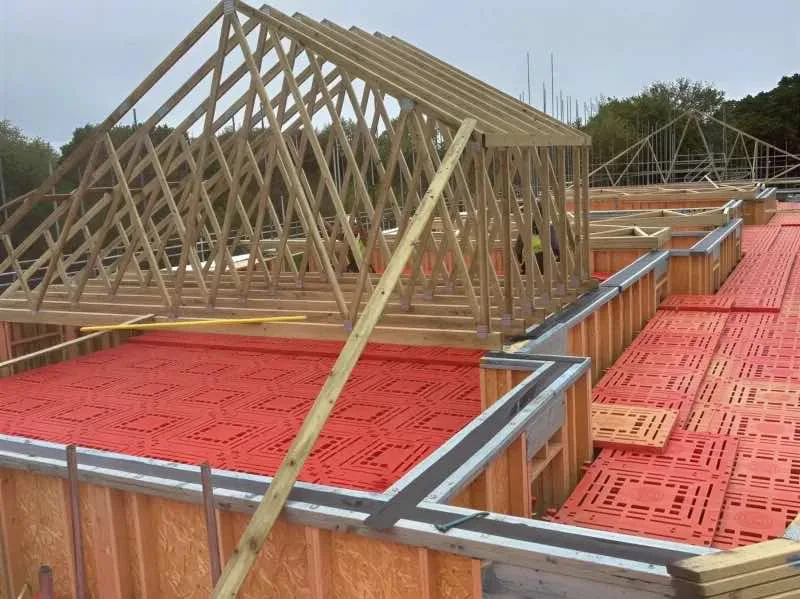
1,200 m² Crash Deck, Cardiff
Our biggest project to date — a 1,200 m² T-Deck crash deck spanning multiple plots of a Cardiff residential development, completed in 2025 and signed off by a CISRS-qualified supervisor.
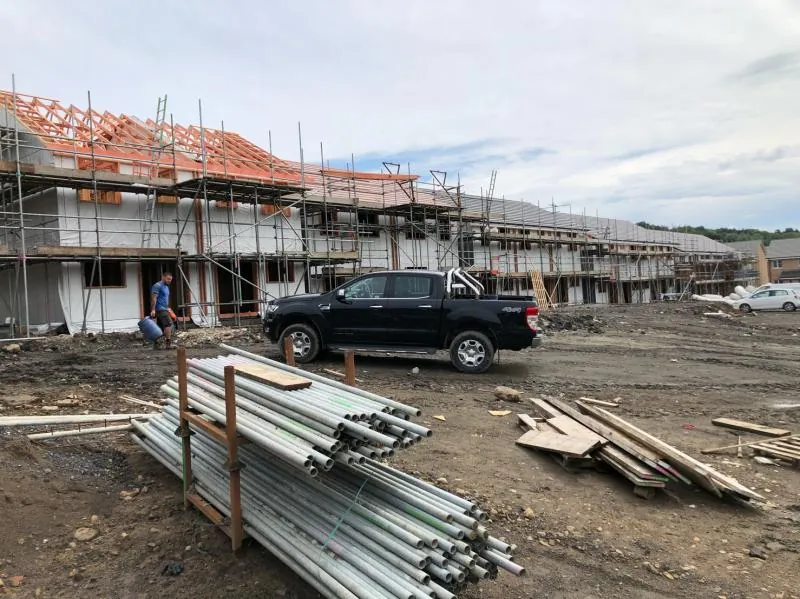
Persimmon Homes, Creigiau
A comprehensive scaffolding and T-Deck safety solution for Persimmon Homes, supporting the rapid delivery of 1,500 new-build homes in Creigiau, Cardiff — delivered by Trust Scaffolding as a long-term supply chain partner.
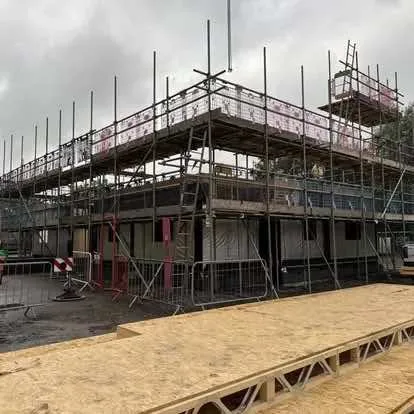
Persimmon Homes, Bridgend
An ongoing, multi-phase scaffolding and T-Deck safety decking programme for Persimmon Homes across Bridgend — a total package of external access and internal fall arrest, delivered as a strategic supply chain partner to one of the UK's largest house builders.
Accredited By
Being a member of The Scaffolding Association as Audited Contractors is but one of many accreditations and certifications that we hold.